PulseDev for Laravel.Click it, fix the Blade.
Click any element in your running Laravel app and say what’s wrong. Your agent opens the Blade view or Livewire component behind it and proposes a diff you approve before it’s written.
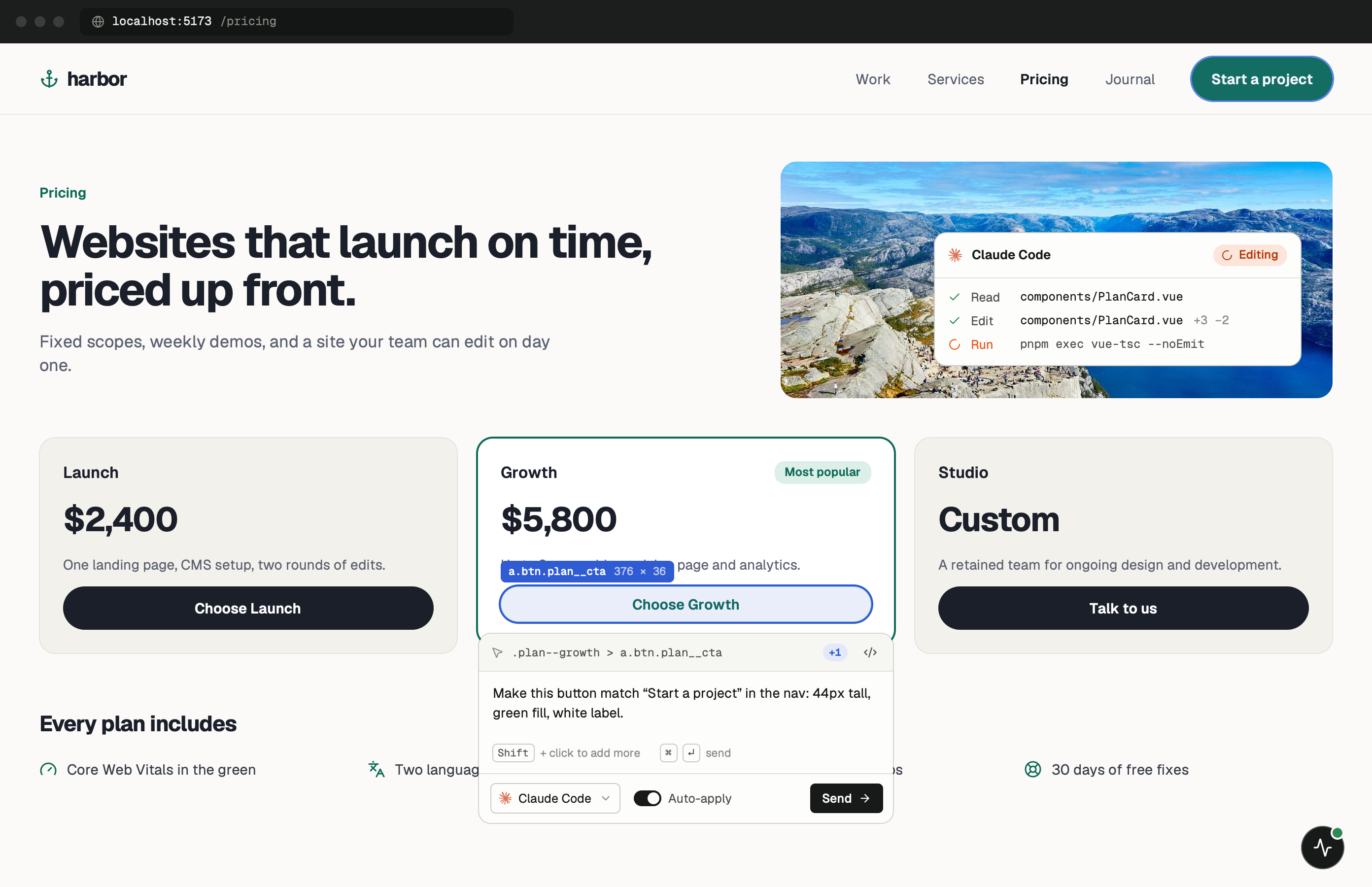
Blade views, partials and your local URL.
A Laravel page is usually a layout in resources/views/layouts, a view that extends it, and a few @include partials or Blade components. The rendered HTML doesn’t say which file each piece came from, so the agent traces it back from the page URL and the markup you clicked. routes/web.php often points it at the right controller and view.
One thing differs from JavaScript frameworks: the address your site runs on. At http://localhost:8000 from php artisan serve, everything works as is. With Herd, Valet or a hostname like myapp.test, the widget’s requests come from an origin that isn’t localhost, and the PulseDev server rejects them until you turn on Allow any origin in Settings › General › Network.
One minute of setup.
None of it ships.
Set up project looks for an index.html, which Laravel doesn’t use for its pages, so add the snippet to your main layout yourself. On an Inertia app with React or Vue, it will also try to add @pulsedev/vite to vite.config.js, which isn’t on npm yet. Using a .test domain?
- Add
Paste the tag into your layout.
Put it before </body> in the layout every page extends. @env('local') renders it only when APP_ENV is local.
resources/views/layouts/app.blade.php @env('local') <script src="http://localhost:3899/widget.js" data-token="YOUR_TOKEN"></script> @endenv - Run
Start Laravel.
php artisan serve, Sail, Herd or Valet all work. If the URL in your browser isn’t localhost or 127.0.0.1, turn on Allow any origin first.
terminal $php artisan serve
Notes for
Laravel apps.
Mostly about hostnames, partials and how changes show up.
Herd, Valet and .test domains
Pages served from myapp.test are a different origin from localhost. Turn on Allow any origin, then restart the project in PulseDev. The project token is still required.
Livewire
Livewire output is regular HTML, so its components are clickable. wire:navigate swaps the page body on navigation; if the PulseDev button disappears, reload the page.
Blade components
Anonymous components in resources/views/components and class-based ones in app/View/Components both render to plain HTML. The agent edits whichever file holds the markup.
Approve, then refresh
With npm run dev running and refresh: true in laravel-vite-plugin, the page reloads when the approved change lands. Otherwise reload the tab yourself.
Laravel questions.
- Can I use it with Inertia.js?
- Yes. The Inertia root view is a Blade file, usually resources/views/app.blade.php. Put the snippet there.
- Does Sail work?
- Yes. Sail forwards the app to localhost on your Mac, and the widget connects from your browser to the PulseDev app, not from inside the container.
- My APP_ENV isn’t local. What do I change?
- Change the directive to match, for example @env(['local', 'staging']). Avoid loading it on anything public.
- Does it support Blade components and Livewire?
- Yes. Both render to HTML before the browser sees them, and the agent edits the Blade or PHP files behind them.
Your Laravel app is running.Go point at the bug.
Windows coming soon. Free to start.